2-Day Full-Body Workout for Busy Beginners
By Answer Fitness editorial ·
Two full-body days a week are enough to start, if those days actually happen. This plan is for a busy beginner who can protect two sessions and wants each one to train the whole body. It is not a promise of a particular body, and it is not the right first step if a clinician has told you to avoid lifting.
The World Health Organization asks adults to strengthen major muscle groups on at least two days a week. The American College of Sports Medicine’s 2009 progression stand also starts novices at two to three days a week, with loads in an 8–12 repetition range. Two days meets that floor. It does not replace a check-in if you have pain, a recent injury, or a condition that changes how you should train.
Who it fits, and who should change it
Use it if you are new, or you have been away from lifting for a long time, and two days is what your week can hold. Skip the loads below and get advice first if lifting reproduces joint pain, you are recovering from surgery, or you are pregnant and have not been cleared for resistance work. “Beginner” here means the exercises are new to you, not that you are unfit.
If you can already train three days, the three-day beginner gym plan and the full-body workout plan give you another session instead of cramming more into these two.
Equipment
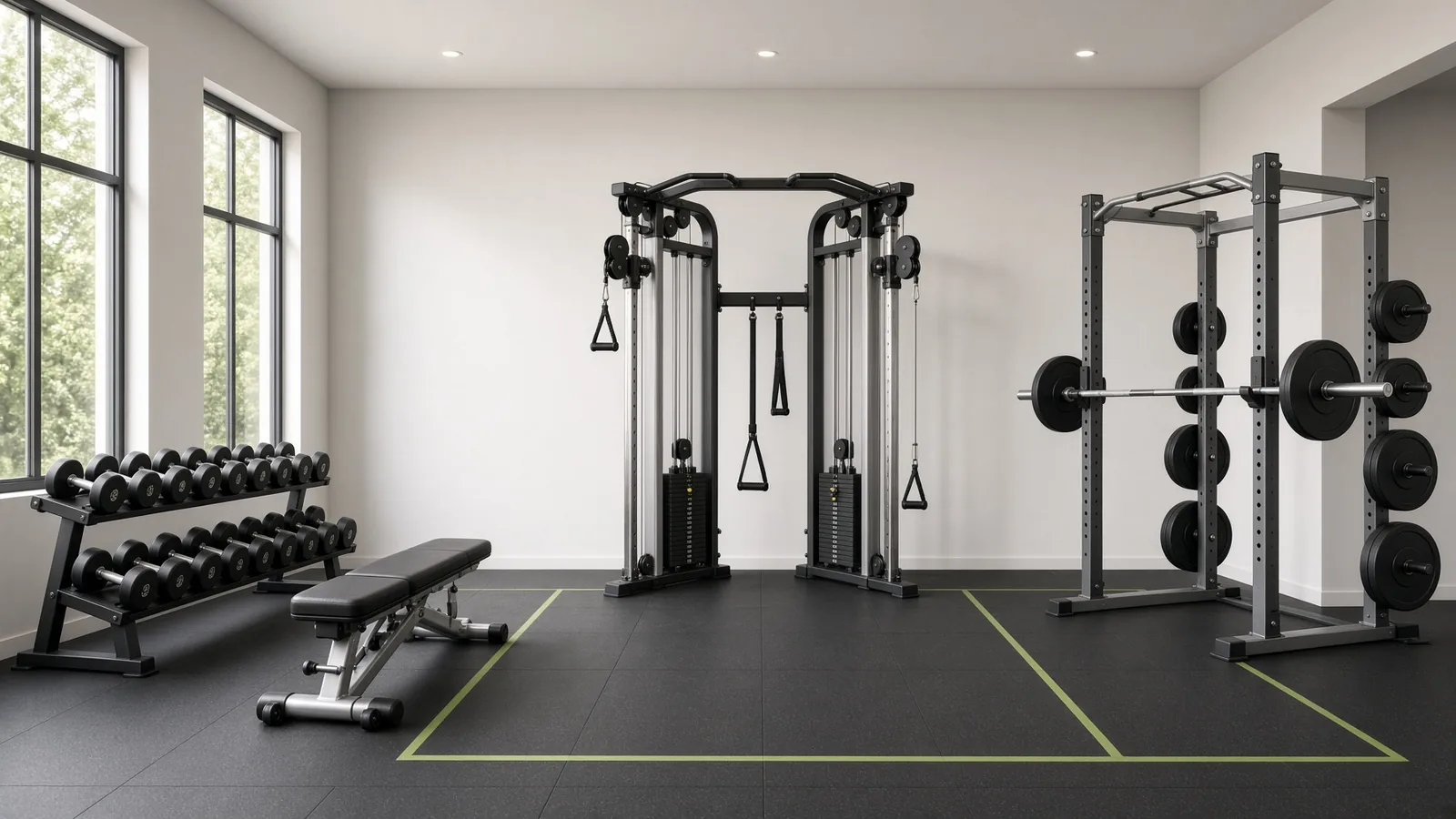
A pair of dumbbells you can still make heavier later, a stable bench, and a mat cover both sessions. A backpack with books can stand in for a light dumbbell at home. Bands work for the pulls if you do not have a cable. You do not need a rack yet. The dumbbell-only full-body workout is the same idea with fewer machines.
How to read sets, reps, and rest
A line like “3 × 8–10” means three sets of eight to ten repetitions. A set is one group of repetitions done before you rest. Rest is the pause between sets, not between every single repetition. On the first three exercises, rest about 90 seconds to 2 minutes so the next set still looks like the first. ACSM’s stand uses longer rests, about 2–3 minutes, when the goal is heavy strength on big lifts. In a beginner session, 90 seconds to 2 minutes is a practical middle. If the next set falls apart, rest longer instead of shortening the pause until the reps get sloppy.
“Leave 1–3 reps in reserve” means you stop when you could have done one to three more reps with the same form. That is not a medical test. It is a way to stay short of failure while you learn. The names for it are in RPE and reps in reserve.
Session A
| Exercise | Sets | Reps | Rest | If you lack the tool |
|---|---|---|---|---|
| Goblet squat | 3 | 8–10 | 90–120 s | Bodyweight squat to a chair, or a leg press |
| Dumbbell bench or floor press | 3 | 8–10 | 90–120 s | Push-up on a bench or the floor |
| One-arm dumbbell row | 3 | 8–10 each side | 90–120 s | Band row or seated cable row |
| Dumbbell Romanian deadlift | 2 | 8–10 | 90 s | Hip hinge with no weight, hands on thighs |
| Farmer carry or plank | 2 | 20–30 m, or 20–40 s | 60 s | Suitcase carry with one dumbbell |
Session B
| Exercise | Sets | Reps | Rest | If you lack the tool |
|---|---|---|---|---|
| Split squat or step-up | 3 | 8 each side | 90–120 s | Rear-foot elevated only if the knee stays comfortable |
| Dumbbell shoulder press | 3 | 8–10 | 90–120 s | Seated press, or a machine shoulder press |
| Pulldown or band pulldown | 3 | 8–10 | 90–120 s | Assisted pull-up, or an inverted row under a sturdy table |
| Glute bridge | 2 | 10–12 | 60–90 s | Same bridge with feet closer to you |
| Easy walk or bike | 1 | 5 minutes, optional | — | Skip it if you are out of time |
Put at least one full day between Session A and Session B. Monday and Thursday works. So does Tuesday and Saturday. Do not run them back to back just to “finish the week.”
How heavy, for a beginner
Pick a load you can move for 8 reps with the same speed on the last rep as the first, and still have 1–3 reps left. If you only reach 6 clean reps, it is too heavy. If 12 is easy and the next jump is huge, stay at this weight and add reps until you earn a 2–10% load increase, which is the step ACSM suggests once you can beat the top of the range by a rep or two. Upper-body jumps are often smaller than leg jumps. Write the weight down. The progression guide is the longer version of that rule.
Warm-up
Five minutes is enough: easy walk or bike, then two lighter sets of the first exercise, such as an empty-handed squat and one set with about half the working weight. Use the warm-up before lifting if you want the longer ramp. Do not skip it to save the session for extra sets.
What to write down
After each exercise, note the load, the reps you actually did, and whether the last set still had a rep or two left. That is the whole log. A blank page is fine. The workout log page lists what is worth keeping. When every set of an exercise hits the top of the rep range with clean form, add a little weight next time. If a set loses form, stop the set. Do not add a third session to “make up” a light day.
If you miss a day
Do the missed session on the next day you can train, then leave at least one day before the other session. If the whole week collapses, start the next week with Session A. Do not stack both sessions on Sunday. Two calm days beat one exhausted day. If most weeks are shorter than 40 minutes, use the 30-minute workout guide to cut sets, not rest, first.
Compare this two-day week with upper/lower and push/pull/legs in full body vs upper/lower vs push pull legs before you add days you will not keep.
Sources
- American College of Sports Medicine. Progression models in resistance training for healthy adults. Med Sci Sports Exerc. 2009.
- World Health Organization. Guidelines on physical activity and sedentary behaviour. 2020.
- Schoenfeld BJ, Ogborn D, Krieger JW. Effects of resistance training frequency on measures of muscle hypertrophy. Sports Med. 2016.
Published October 2026. Not medical advice. Cover photos are editorial illustrations, not a test of a specific gym.